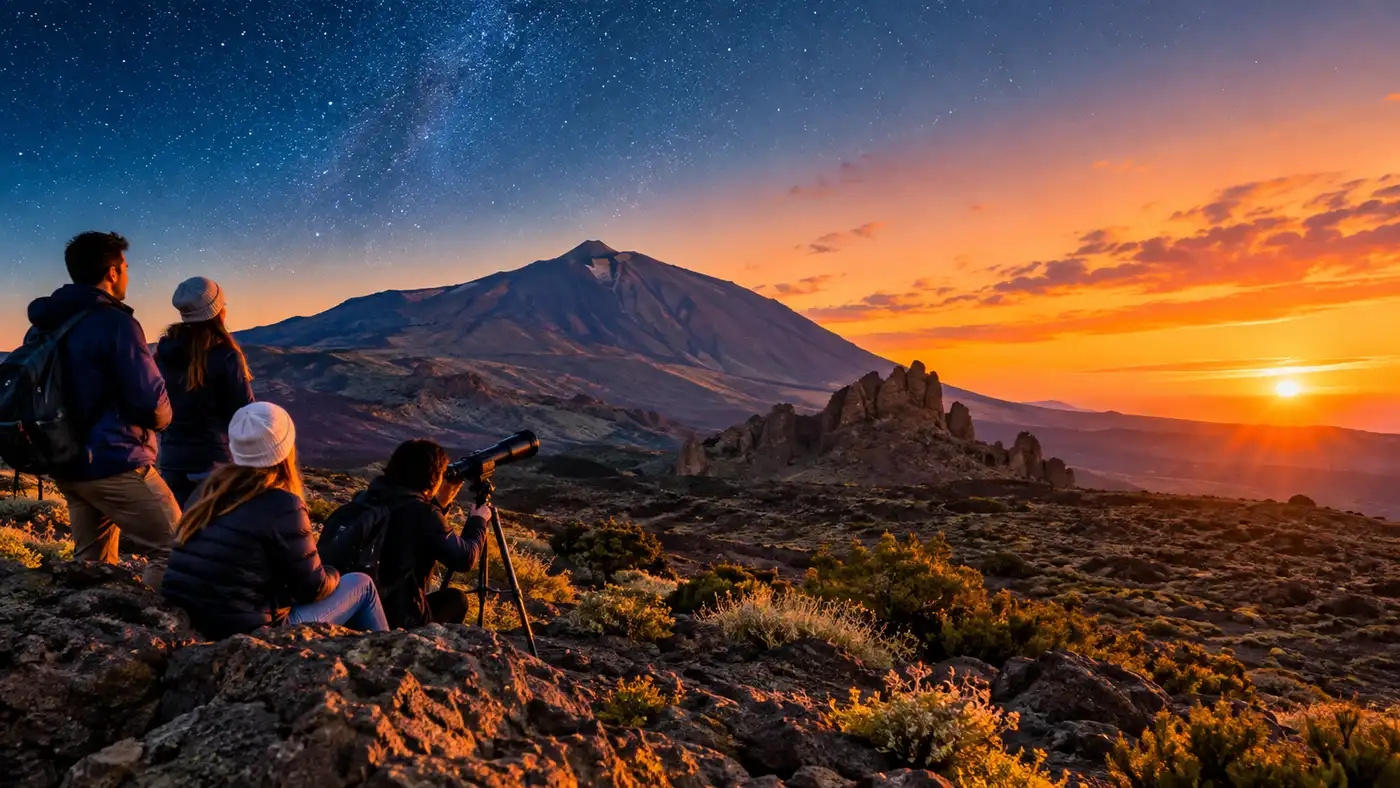
Teide National Park Stargazing and Sunset Experience
The air at 2,200 meters hits your lungs with a dry, chilly snap. Down by the coast in Costa Adeje or Puerto de la Cruz, people are still nursing cold beers in shorts, completely oblivious to how brutal the mountain gets after dark. Experiencing teide national park stargazing changed how I think about dark skies forever. It feels less like looking up from earth and more like floating somewhere out in open orbit.
Tenerife has strict atmospheric protections, steady trade winds, and high volcanic peaks that push you cleanly past the cloud inversion. Up here, you stand on crumbled basalt, look straight into the cosmos, and realize you probably have not experienced true, raw darkness in years. Whether you plan to rent a beat-up hatchback and navigate the hairpin turns yourself or pay for a guided excursion with high-powered telescopes, this guide walks you through the routes, temperatures, dinner options, and the quietest dirt pullouts along the crater rim.
Book your teide national park experience:
Watching the Sunset Teide National Park Creates Over the Cloud Sea
Get up the mountain at least 90 minutes before sunset. If you arrive right as the sun hits the horizon, you will spend the best light fighting for a parking spot instead of watching the colors turn. As the sun drops, the Atlantic trade winds push a dense blanket of marine stratus clouds against the northern slopes of the island. Locals call it the mar de nubes. From above, it looks like an endless sea of whipped cream beating against dark volcanic cliffs.
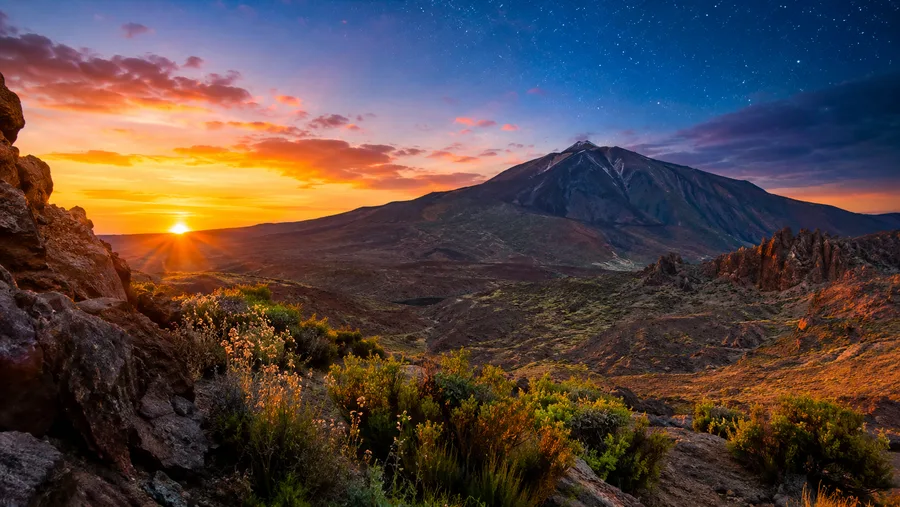
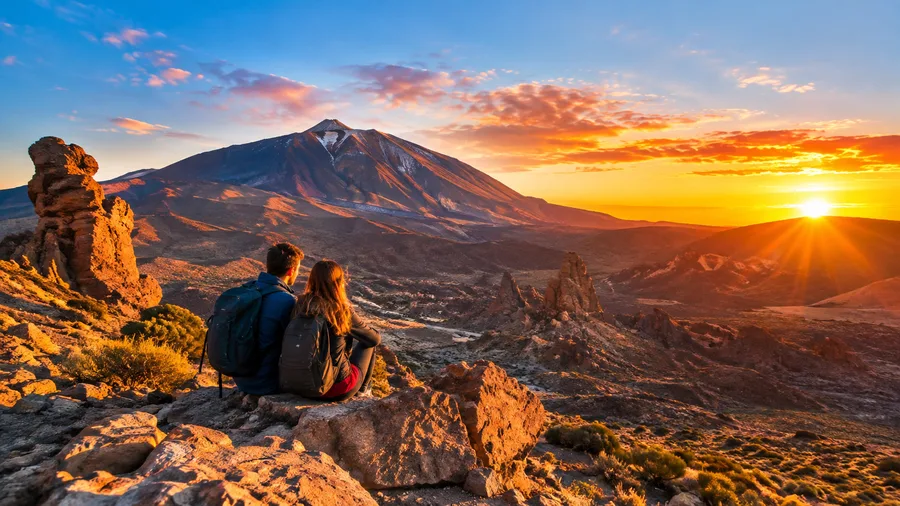
The light changes rapidly. First, the yellow sulfur streaks and ochre pumice fields glow amber, then deep copper, and finally a bruised violet. This teide national park volcanic landscape sunset tenerife offers is unlike anything on the Spanish mainland. Mount Teide itself casts a gigantic triangular shadow that stretches eastward across the caldera, reaching out over the ocean toward the neighboring island of Gran Canaria.
You have dozens of spots to choose from along the crater floor, but a few viewpoints consistently deliver clear views of the teide national park lava landscape sunset:
- Mirador de Chío: faces west toward La Gomera and La Palma, perfect for seeing the sun vanish into the ocean.
- Llano de Ucanca: offers massive, flat gravel plains with the Roques de García and Mount Teide looming behind you.
- Mirador de las Narices del Teide: overlooks the 1798 eruption vents on the western flank, where old black lava flows look completely prehistoric under orange light.
- Mirador de San José: sits inside a pale yellow pumice field that looks remarkably like the surface of Mars.
Pro tip: Bring a sturdy thermos filled with hot coffee or ginger tea. The moment the sun drops below the distant cloud layer, the temperature plunges 8 to 10 degrees Celsius in less than fifteen minutes.
Why Mount Teide by Night is a Starlight Reserve
Mount teide night conditions are legendary among astrophysicists. The mountain holds an official certification as a Starlight Reserve, awarded by the Starlight Foundation in compliance with UNESCO standards. Because Tenerife's coastal cities sit beneath a persistent cloud layer that blocks urban glow, the high-altitude volcanic plateau stays pitch-black. Streetlighting across the entire island is regulated by Canary sky laws passed in 1988, mandating down-turned sodium vapor fixtures and strict curfew hours for decorative lighting.
You can see 83 out of the 88 recognized constellations from this latitude. Because Teide sits close to the equator at roughly 28 degrees north, you get an uninterrupted view of the Northern Hemisphere constellations alongside large swaths of the southern sky that remain invisible from central Europe. The famous Teide National Park Observatory, run by the Instituto de Astrofísica de Canarias, sits along the northeastern ridge for this exact reason.
During summer months, the teide national park milky way looks like a dense, luminous steam cloud rising out of the southern caldera wall. In winter, Orion stands enormous and crisp directly over the crater rim. The air is so thin and dry that the stars do not twinkle violently like they do near sea level. They burn steady and quiet, like tiny white pins pushed through black paper.
Note: The cable car does not operate at night for regular ticket holders. Do not drive to the base station expecting to hitch a ride to the summit after dark unless you have booked an exclusive, high-end private evening package months ahead.
Choosing a Teide National Park Stargazing Tour or Self-Driving
You can do this alone, or you can pay someone who owns two thousand euros worth of optical glass to guide you. If you choose to drive yourself, you need to be comfortable handling winding mountain roads in pitch darkness with no guardrails in several places. Driving up through Vilaflor on the TF-21 is straightforward enough, but the descent late at night requires steady concentration. If you need step-by-step driving directions and bus route schedules, read our breakdown on how to get to Teide National Park.
A guided teide national park stargazing tour removes the stress of driving and adds serious educational depth. Guides usually bring large motorized Dobsonian or Schmidt-Cassegrain telescopes, laser pointers that reach into the sky, and deep knowledge of Greek mythology and astrophysics. Some excursions market themselves as a night sky star safari teide national park tenerife visitors love for families, complete with padded chairs and hot chocolate.
If you want a more leisurely evening, look for a teide national park night tour with dinner. These packages, often listed as a teide national park cena experience, typically include a multi-course Canarian meal with local red wine at a traditional bodega in Vilaflor or right inside the caldera at the state-run hotel. If you want to sleep directly inside the park to avoid the midnight drive back down the mountain, check our guide to where to stay in Teide National Park.
| Experience Type | Approximate Cost | Equipment Provided | Best For |
|---|---|---|---|
| Self-Drive Stargazing | Free (car rental only) | None (bring your own binoculars) | Independent travelers, photographers |
| Standard Stargazing Tour | €35 - €50 per person | Pro telescopes, green laser pointers | Budget-minded travelers, casual observers |
| Sunset & Stars Star Safari | €75 - €95 per person | High-end optics, warm coats, transport | First-time visitors, families with older kids |
| Sunset Guided Tour with Dinner | €120 - €155 per person | Telescopes, coach ride, full dinner | Couples, romantic outings, no-hassle evenings |
Teide national park stargazing tour prices fluctuate based on pickup locations. If a tour operator has to haul a bus out to Los Gigantes or Puerto de la Cruz, expect to pay on the higher end of those ranges. Basic astronomy meetups where you drive your own car to the caldera to meet the astronomer are considerably cheaper, usually running around €35 to €45 per adult.
Book your teide national park experience:
Essential Prep for Teide National Park Night Skies and Freezing Temps
People make the mistake of under-dressing every single night. I have seen tourists shivering in flip-flops and thin cotton hoodies, teeth chattering so violently they could not keep their eyes still against the telescope eyepiece. Do not be that person. At 2,200 meters, night temperatures routinely dip down to 2 or 3 degrees Celsius in spring and autumn, and well below freezing during winter. Even in July and August, a breeze can make 11 degrees feel like freezing when you are standing motionless on a gravel shoulder for two hours.
Pack with intention. You need layers that trap heat, plus gear that preserves your night-adapted vision:
- Warm outer shell: windproof jacket, thick fleece, and long trousers are mandatory.
- Headwear and gloves: lightweight thermal gloves make adjusting camera dials or holding metal binoculars bearable.
- Red light headlamp: white phone screens and standard torches instantly destroy the rhodopsin in your eyes, taking 25 minutes to rebuild your night vision.
- Full tank of fuel: there are zero fuel stations open inside the crater after dusk, with the nearest pumps located miles down in Vilaflor or La Esperanza.
It takes roughly thirty minutes for your pupils to dilate fully in pure darkness. Once they do, the sky explodes. You start spotting faint satellite trails, shooting stars, and subtle variations in interstellar dust lanes that you could not see when you first stepped out of the car. Treat that vision gently, keep your headlights off when parked, and step carefully over the rough volcanic gravel.
Moon Phases, Seasons, and Teide National Park Stars
Moon cycles dictate your experience entirely. Many travelers book a stargazing teide national park excursion during a full moon, only to find the sky washed out. A bright full moon turns the caldera floor into an eerie, glowing landscape that looks like the surface of the moon, which is undeniably stunning, but it wipes out deep-sky objects, distant galaxies, and the Milky Way. If you want to see faint star clusters and nebulae, schedule your outing within four days of a new moon.
Summer offers the most comfortable temperatures and prime positioning for the galactic core. From June to September, the densest part of our galaxy stands tall in the southern sky, providing brilliant targets for wide-angle astrophotography. Summer is also prime time for the Perseid meteor shower around August 12, when dozens of green fireballs streak across the caldera every hour.
Winter brings biting frost and sometimes snow, but the air is exceptionally stable and transparent. The winter sky features the Pleiades, the Orion Nebula, and Sirius shining with unmatched brilliance. The Geminid meteor shower in mid-December often outperforms the summer Perseids, provided the access roads remain open. Check the park webcams and road closure notices before you head up, because ice can shut down the TF-21 with little warning.
If you stay out past 3:00 AM, the crater falls into complete, eerie silence. The wind dies down, the tour buses have long departed, and the solitude feels ancient. Watch long enough, and you might catch the first pale signs of dawn creeping over the eastern ocean, capping off an unforgettable teide national park night sky encounter.
Frequently Asked Questions about teide national park stargazing
What is the best month for teide national park stargazing?
July and August offer the clearest weather, warmest night temperatures, and the most dramatic views of the Milky Way core. Winter months bring sharper atmospheric clarity and brilliant constellations like Orion, but sub-zero temperatures and occasional snow can close mountain roads.
How much does a teide national park stargazing tour cost?
Basic guided stargazing where you meet the astronomer directly in the park costs around €35 to €50 per person. Full-service packages including hotel transport, jacket rentals, sunset champagne, and dinner range from €90 to €160 depending on the inclusions.
Can I visit Teide National Park at night without a guide?
Yes, public roads and roadside viewpoints inside Teide National Park remain open 24 hours a day with free access. You can drive up, park in designated pullouts like Mirador de Chío or Llano de Ucanca, and stargaze on your own without any permits or fees.
Where are the best spots in the park for night photography?
Llano de Ucanca offers dramatic foreground rock formations framed directly against the southern horizon. The Roques de García area is fantastic for framing Mount Teide alongside the North Star for star trails, though you will encounter other photographers there on moonless nights.
Quick Reference
- Altitude: 2,000 to 2,356 meters above sea level
- Night temps: 0°C to 12°C depending on season
- Caldera access: open 24/7 with zero admission fee
- Peak viewing: 3 days before and after a New Moon
Book your teide national park experience:
The Bottom Line
Driving up above the clouds to watch the sun slip away over the Atlantic is easily one of the most memorable things you can do on Tenerife. Stay warm, watch your step on the volcanic scree, give your eyes time to adjust to the pitch black, and let the sheer scale of the universe do the rest.
Read more about teide national park.